
Latest News
« Previous Entries Next Entries »Classic work of emigrant oral history relaunched for 25th anniversary
Tuesday, June 30th, 2015A classic work about emigration has been revised and reissued in a twenty-fifth anniversary edition. “Models for Movers: Irish Women’s Emigration to America”, by Dr Íde B. O’Carroll, will be launched by UCD Professor Margaret Kelleher on Wednesday, 15 July 2015 at 6 pm at in the Long Room Hub at Trinity College in Dublin. The event will be hosted by Dr Catherine Lawless of the Centre for Gender and Women’s Studies at TCD; the Minister for Diaspora Affairs, Jimmy Deenihan, will make opening remarks.
The publishers’ website describes the book:
Models for Movers: Irish Women’s Emigration to America is a unique collection of Irish women’s oral histories spanning three waves of twentieth-century emigration to America in the 1920s, 1950s, 1980s. The author provides a critical gender analysis of Irish society during the three migration waves to illustrate conditions for women prior to departure. The oral histories detail how each woman created an independent life for herself in America, often in the face of multiple challenges there. As active agents, often supporting one another to leave, these Irish women are role models because they inspire us to have the courage to act. The women’s voices also speak to and against the regulated silences surrounding both emigration and the reality of Irish women’s lives. Finally, they provide a rich multigenerational tapestry of experience into which women leaving Ireland today, often for places other than America, can weave their stories.•This book used an oral history approach to documenting Irish emigration history – an approach considered “ground-breaking” at the time• This revised twenty-fifth anniversary edition comes at a time of renewed global Irish migration•The Models’ project materials formed the basis of the first holding on Irish women at the Schlesinger Library, Harvard University, the premier repository on the History of Women in America – the O’Carroll Collection.
Author Dr Íde B. O’Carroll is an Irish-born social researcher and writer who divides her time between Amherst, MA and Lismore, Waterford; she is also a Visiting Scholar at NYU’s Glucksman Ireland House.
To RSVP for the launch, contact Cork University Press Tel: 00 353 (0)21 4902980 or email corkuniversitypress@ucc.ie. To order the book, visit the Cork University Press website.
Global Irish Civic Forum to take place this week in Dublin
Wednesday, June 3rd, 2015The first-ever Global Irish Civic Forum will take place in Dublin Castle this week, with over 175 delegates from 17 countries and representing more than 140 organisations in attendance. Those attending include representatives of more than 140 organisation assisting vulnerable emigrants, supporting Irish culture abroad, networking Irish business people, and campaigning on issues affecting emigrants.
One issue that will be sure to be on the minds of many participants will be that of voting rights for emigrants. Following last month’s phenomenal “#hometovote” movement, which saw a large and unprecedented number of emigrants returning home to vote, it is likely that many of the delegates will be eager to talk about new ways of engagement in an Ireland to which many are likely to return.
Panel discussions will focus on such issues as identity and heritage, assistance on returning to Ireland, challenges facing new emigrants, supporting the mental well-being of emigrants, and more. The Forum will no doubt be well-covered on social media, and the suggested hashtag on Twitter is #diaspora15.
Ahead of the event, Minister for Foreign Affairs Charlie Flanagan said,
“I am very much looking forward to engaging with the participants attending the Global Irish Civic Forum. The event is particularly timely as we are starting to see the tide of emigration turning in response to steady economic recovery. Our focus is now shifting to facilitating those emigrants abroad who wish to return.
“The forum is also a unique opportunity to thank the many organisations working throughout the world to support our emigrants in making new lives far from home.”
Minister for the Diaspora Jimmy Deenihan stated:
“I look forward to lively and engaging discussions with representatives of groups working with our emigrants abroad over the course of the Global Irish Civic Forum. Many of the groups represented are recipients of funding under the Emigrant Support Programme which has demonstrated the Government’s support and commitment to global Irish communities since 2004.”
Here is the programme outline:
Wednesday 3 June
- Welcome Address by Minister for Diaspora Affairs Jimmy Deenihan T.D.
- Panel Discussion on challenges facing new Irish emigrants
- Panel Discussion on Irish Identity and Heritage
- Panel Discussion on reaching out to Irish citizens abroad
- Panel Discussion on supporting the mental wellbeing of Irish emigrants
- Reception hosted by President & Mrs. Higgins
Thursday 4 June
- Address by Minister for Foreign Affairs & Trade, Charles Flanagan T.D.
- Panel Discussion on assisting emigrants returning to Ireland
- ‘Diaspora Engagement – Past, Present and Future – How and Why Diaspora
- Matters’, Kingsley Aikins
- Presentation by John Concannon, Director of the Ireland 2016 Project Team
- Afternoon Workshops for Irish community organisations: fundraising,
- communication and governance
- Closing Remarks by Minister for Diaspora Affairs Jimmy Deenihan T.D.
See the full programme on the UCD Clinton Institute website.
Watch recorded proceedings on the Department of Foreign Affairs website.
“My heart leaped up with so much joy:” Happy St Patrick’s Day!
Tuesday, March 17th, 2015Every St Patrick’s Day, I am reminded of my favourite book, The Hard Road to Klondike, and Micheál MacGowan’s poignant story of St Patrick’s Day in All Gold Creek in the Yukon. In case you’re not familiar with the book, it’s the translation from Irish of the oral memoir of Donegal native Micheál MacGowan’s adventures in Montana and the Alaskan Gold Rush. It’s wonderful.
I love the story of this impromptu St Patrick’s Day parade (probably Alaska’s first!), not least because it’s true. MacGowan’s tale captures the camaraderie, fun and poignancy of a good St Patrick’s Day celebration far from home. The story opens early on St Patrick’s morning with our hero, high in the hills, five miles from the nearest village, gathering a can of snow to melt for water for his breakfast.
As I stood there, suddenly I thought I heard pipe-music in the distance. At first I thought it was a dream but in a short while I heard it again. I straightened up then so as to hear it better but as luck had it, didn’t the piper stop playing as soon as I was in a position to listen properly. It was some time before he started up again but when he did he seemed to be closer and the music was clearer; and wasn’t the tune he was playing ‘St. Patrick’s Day’! I’d say that by then the piper was three or four miles away up in the hills behind us; there, then, was I, three thousand miles from home but, in the time it would take you to clap your hands, I fancied I was back again among my own people in Cloghaneely. My heart leaped up with so much joy that I was sure it was going to jump out of my breast altogether.
I ran back into the cabin and told my friends what was happening. They came out and when they heard the music, they were so overjoyed that one of them rushed around with the news to all the Irishmen in the neighbouring cabins. They too got up and when they also heard the pipe-music coming towards them they nearly went out of their minds. They went roaring and shouting around the place so much that you could hear the echoes coming back out of the mountains and valleys surrounding us. Everyone waited there until we felt the piper was coming near to us and then we all went out to meet him. Nobody was fully clothed and half of us hadn’t eaten at all but our blood was hot and despite the frost none of us felt the cold a bit! When we met him, we carried him shoulder-high for a good part of the way back. He was brought into our cabin and neither food nor drink was spared on him. And it was still early in the day.
When everyone was ready, he tuned his pipes and off we went four abreast after him like soldiers in full marching order. There wasn’t an Irish tune that we had ever heard that he didn’t play on the way down the valley. Crowds of people from other countries were working away on the side of the hill and they didn’t know from Adam what on earth was up with us marching off like that behind the piper. They thought we were off our heads altogether but we made it known to them that it was our very own day—the blessed feast-day of St. Patrick. On we marched until we came to the hotels and we went into the first big one that we met. Without exaggeration, I’d say that there were up to six hundred men there before us—men from all parts of the world. We were thirsty after the march and, though we hadn’t a bit of shamrock between us, we thought it no harm to keep up the old custom and to wet it as well as we were able.
We had a couple of drinks each and, as we relaxed, I stood up and asked the piper to tune up his pipes and play us ‘St. Patrick’s Day’ from one end of the house to the other. The word was hardly out of my mouth before he was on his feet…
The men drown the shamrock exuberantly at the town’s hotels, their day only briefly disrupted by the violent dispatch of an Orangeman who didn’t appreciate the celebrations. (We’ll skip that bit.)
As night fell, we all gathered ourselves together again and set off up the hill along the way we had come until we reached our own cabins again. We were tired out and it wasn’t hard to make our beds that night. The piper spent the night with us and next morning he bade us farewell and went off to the back of the mountain where himself and two friends of his were working.
A loyal good-natured Irishman, like thousands of others of his race, he left his bones stretched under frost and snow, far from his people, out in the backwoods, where none of his own kith would ever come to say a prayer for his soul. We heard that he had been killed in one of the shafts shortly after he had come to us to keep the Feast of St. Patrick with his music in All Gold Creek.
A bit of a sad ending there, but MacGowan himself had a much happier one. He went home to Donegal in 1901, travelling first class with the fortunes he brought from the Gold Rush. “I had seen enough of modern times in America; and it was like a healing balm to find myself under the old rafters again.” He decided to stay in Donegal, fell in love, married, and raised a family – and MacGowan, one of Ireland’s greatest emigrant adventurers, declared he would rather see one of his eleven children “gathering rags” than heading for America.
Happy St Patrick’s Day – I hope you’re parading where ever you are!
- You can read a full book review I wrote several years ago over at the Emigrant.ie website.
- I also wrote the entry on Michael MacGowan in Ireland and the Americas.
- You should probably buy the book.
Uplift.ie begins emigrant voting rights petition campaign
Monday, March 16th, 2015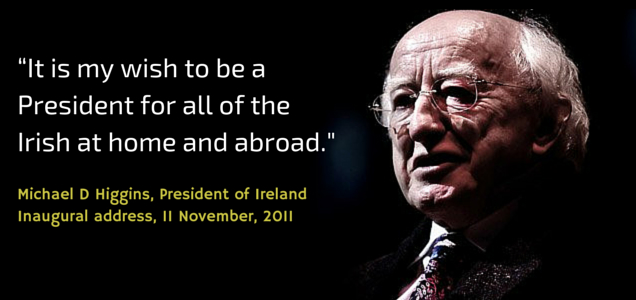
The activist website Uplift.ie has begun a new petition campaign calling on Taoiseach Enda Kenny to end his refusal to hold a referendum on the rights of Irish citizens living overseas to vote in presidential elections.
More than 120 countries have provisions for their citizens abroad to cast a ballot. Ireland does not. Engagement with Irish citizens abroad has long been of enormous importance for Ireland. It has been a distinctive feature of efforts to bring a lasting peace to the island. It has built economic links resulting in trade, investment and tourism and the achievements of our citizens have enhanced Ireland’s profile and reputation internationally.
The issue of voting rights for citizens outside the State has huge popular support and was also recommended by the Convention on the Constitution. The Government recently considered their response to the recommendation of the constitutional convention but have now decided not to go ahead with the referendum needed to allow Irish citizens living abroad to vote in Presidential elections.
In their Twitter campaign promoting the campaign, Uplift.ie quoted yours truly in an infographic.
In a nutshell @NoreenBowden captures why the #Right2Vote is an NB democratic issue. Act now https://t.co/SjXnYxneh4 pic.twitter.com/Infs4WflSx
— Uplift (@UpliftIRL) March 16, 2015
The petition has 727 signatures as of this writing. Add your name at Uplift.ie.
Sign the petition to save longwave
Monday, October 13th, 2014Update: RTE has backed down from the decision to shut down longwave broadcasts. They will keep broadcasting for an additional two years, until May 2017. The Department of Foreign Affairs has also pledged to conduct a study focusing on the needs of listeners. Read more details at the IrishinBritain website.
There is now a petition up at Change.org asking RTE to postpone the move to shutdown longwave.
You might want to sign it, too. Here is the text:
We are requesting that RTE keep its broadcasting services to the Irish in Britain. RTE announced with one month’s notice that it would shut down its longwave service on October 27. This move was done with no consultation with its listeners, and will be a significant loss to the whole Irish community.
A wide section of the Irish community listens to RTE Radio 1 on longwave in Britain – people of all ages listen in their cars, sports fans hear GAA matches, and for many older emigrants, it is a treasured link with home. There are no adequate alternatives for many people: RTE advises listening online or via satellite, but these are not accessible to everyone. Listeners in Britain (and Northern Ireland) will not be able to use DAB, which RTE is also pushing as an alternative, as that signal is only available in parts of Ireland.
Older people are likely to be hardest hit by the shutdown, and many of them will lose this powerful link with Ireland forever. As the chair of the Provincial Council of the GAA of Britain, Brendie Brien, has said, longwave provides “a home from home – and the shutdown would be depriving them of that.” The shutdown will be “a massive setback to the whole of the Irish community…We have a lot of old people who wouldn’t be into modern IT – and who won’t have any access to Ireland whatsoever once that would go.”
RTE does not know how many people are affected by the shutdown of this vital service and have not released the amount of money this will save. The longwave transmitter is only ten years old.
We are asking for RTE to postpone the longwave shutdown until there are better alternatives for all the Irish in Britain.
The petition is being shared on Twitter and Facebook – please sign and share.
Urging RTE to keep the longwave link for the diaspora in Britain
Monday, October 13th, 2014I have an article in today’s Irish Times arguing that RTE’s impending shutdown of its longwave service will be deleterious to the vitality of the Irish community in Britain. The oldest and most isolated are the ones who will be hurt the most, but the shutdown will actually affect a broad cross-section of the community.
I thought the chair of the GAA in Britain said it best:
Last week Brendie O’Brien, chairman of the GAA in Britain, described the impending shutdown as “a massive setback to the whole of the Irish community”.
“We have a lot of old people who won’t have any access to Ireland whatsoever once that [the longwave service] goes.” O’Brien described Radio 1’s role in the lives of many emigrants as that of providing “a home from home, and the shutdown would be depriving them of that.”
You can read the whole article on the Irish Times site.
« Previous Entries Next Entries »